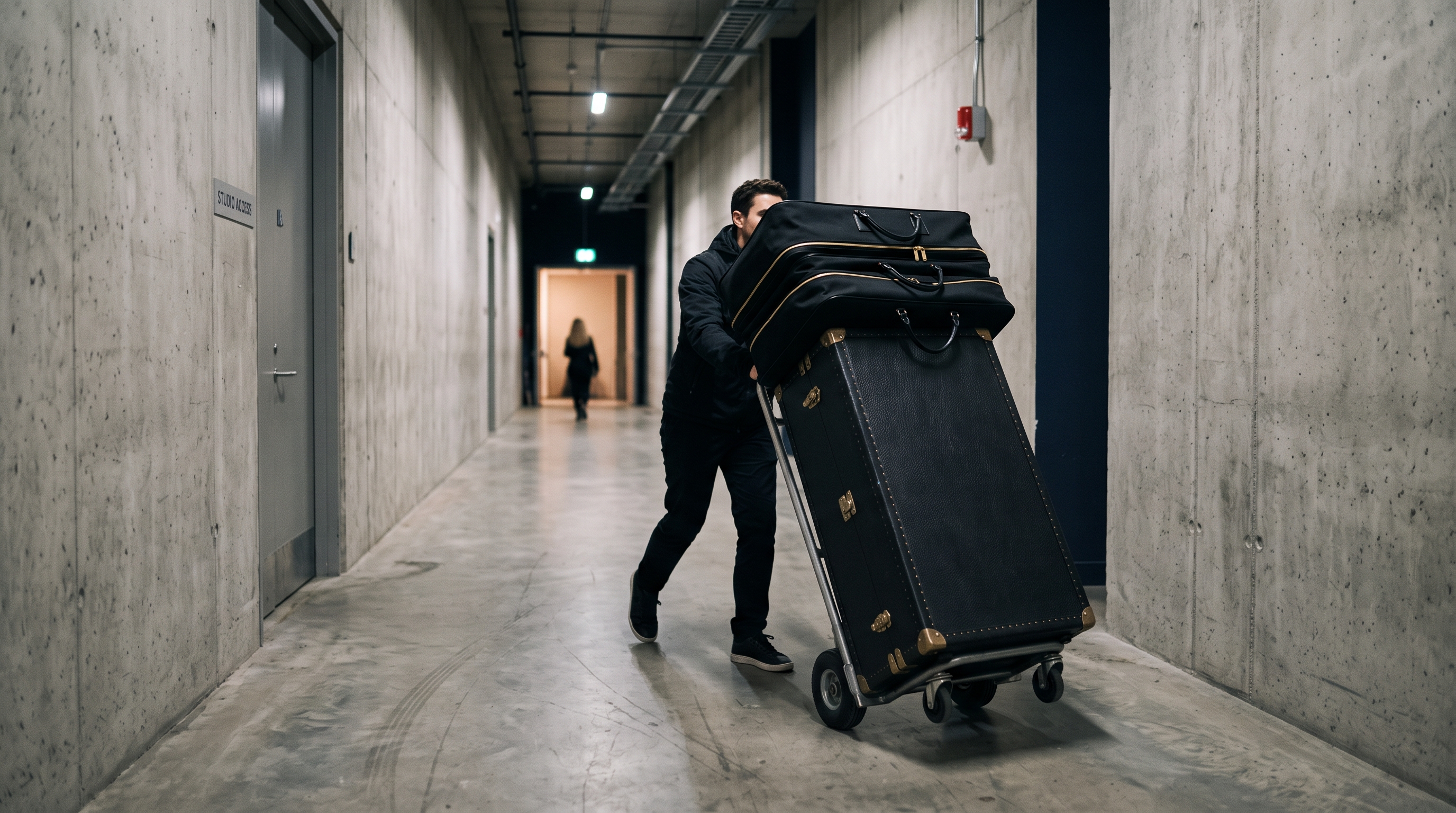
Fashion logistics relies on a customs document that most people never see: the ATA Carnet. Roughly 200,000 of these documents facilitate the movement of more than $25 billion worth of goods across borders each year (USCIB, 2024). Four times a year, the fashion world moves in unison. New York, London, Milan, Paris: the calendar repeats itself, season after season, and with it comes one of the most demanding challenges in the luxury sector.
Nothing about Fashion Week tolerates delays. A look that doesn't arrive on time isn't just late—it simply doesn't exist for that show. In our experience, the paperwork and the security plan determine the outcome long before the truck reaches the venue. So here’s what actually moves between these capitals, and what it takes to get it there intact, on time, and unseen until the moment it’s meant to be seen. Want the bigger picture first? Start with our air freight guide for luxury.
Key takeaways
- About 200,000 ATA Carnets facilitate the movement of more than $25 billion worth of goods across borders each year (USCIB), and fashion week logistics rely heavily on them.
- The schedule is set: New York, then London, Milan, and Paris, twice a year, working backward from a deadline that never changes.
- Runway looks are often the only copies that exist, so confidentiality and security are operational requirements, not PR extras.
- Cargo theft in the U.S. reached a record high in 2024, up 27 percent, with the average loss now exceeding $202,000 (CargoNet).
Why does the fashion week calendar leave no wiggle room?
The Fashion Week circuit follows a set schedule: New York first, then London, Milan, and Paris in the weeks that follow, twice a year for spring/summer and fall/winter (CFDA, 2026). Every fashion house on that calendar works backward from a date that cannot be changed. The show starts when it starts.
That single constraint—an unmovable deadline—changes everything about how these shipments are planned. There’s no next available slot; there’s only the moment the first model steps out. Because the four cities follow one after another, a delay in one capital ripples through to the next. As a result, fashion houses can’t treat each show as a separate job. It’s one continuous relay across borders, and the baton is a collection worth a fortune. New York’s fashion industry alone accounts for more than $24 billion in annual wages, giving a sense of the value riding on that calendar (Office of the Governor of New York, 2024).
What actually moves between the capitals?
Fashion week logistics isn't just about finished garments. A single collection generates a complex web of movements, and each category comes with its own mix of fragility, declared value, and secrecy. For example, a sheer sample dress and a heavy set piece require completely different handling, yet both must arrive on the same day.
- Prototypes and samples, which are often shuttled back and forth between the atelier and the design team for last-minute adjustments right up until the show begins.
- Runway looks are often the only physical copy of a design that exists. Any damage or loss is effectively irreplaceable before the show.
- Accessories and hardware— ranging from shoes to jewelry—are often sourced from different countries and must be brought together at a single location at a specific time.
- Set and scenography materials, which can be just as demanding as the garments, especially for fashion houses known for their elaborate staging.
Because most of this comes from several countries, timing is more important than speed. We've found that the hard part isn't moving any one item quickly; it's getting everything to arrive at the same time. Meanwhile, the value-to-weight ratio remains extremely high, which is exactly why couture flies rather than sails.
What is an ATA Carnet, and why does the fashion industry rely on it?
Most of what appears on a runway is never sold, imported, or exported in the usual sense. It is on loan, moving temporarily from a workshop to a show and back. That’s where the carnet comes in. The ATA Carnet is an international customs document that allows samples, prototypes, and professional equipment to cross the borders of roughly 80 countries duty-free and tax-free, provided the goods are re-exported within a year (ICC; trade.gov).
The scale explains why it matters. Approximately 200,000 ATA Carnets are issued worldwide each year, covering more than $25 billion in temporarily imported goods (USCIB, 2024). For a fashion house holding shows in four capital cities over four weeks, proper handling of the carnets isn't just a technicality. It's what keeps the entire tour financially viable.

Get it wrong, and duties are paid on goods that were never intended to be sold in that country. Get it right, and the entire multi-city shipment remains smooth, fast, and cost-efficient. The carnet is essentially a passport for goods: a single document, a running list of items, and a customs guarantee that they will be re-exported. In our experience, a carnet error rarely stops a shipment entirely; it simply holds it up at a border on the one day the schedule can’t spare. For sales that do cross a border permanently, the logic is different: that’s the world of DDP and VAT-free delivery, where duties are paid, not deferred.
Is confidentiality really a logistics problem?
Yes, and the numbers back that up. Cargo theft in the U.S. reached a record high in 2024, rising 27 percent year over year, with the average loss now exceeding $202,000 per incident (CargoNet via Carrier Management, 2025). For unreleased couture, the risk isn't just financial. A leaked look takes away the element of surprise that the entire show was built around.
Runway looks remain confidential until the very moment they hit the runway. So shipments can’t just be fast; they have to be discreet. Declared values are often extremely high, which raises insurance and security considerations that most freight never faces: unmarked packaging, a controlled chain of custody, and strictly limited visibility into the contents until the fashion house is ready to reveal them. Because a single runway piece can be irreplaceable, security here is a design requirement, not an afterthought. That’s a different approach from ordinary luxury goods logistics, where items can usually be reordered.
How does Stracker manage fashion week logistics?
Coordinating this process involves managing several tasks simultaneously across multiple countries: temporary customs documentation, high-value insurance, tight security, and a delivery window measured in hours. About 200,000 carnets are moved worldwide each year (USCIB, 2024), and those on a show schedule leave no room for redoing the paperwork.
This is where a multi-country network and a hands-on approach are most important. We don't just book transportation; we coordinate it. The samples leaving Paris on Monday, the accessories arriving from Italy on Tuesday, and the staging shipped from a third country all have to arrive exactly where and when they're needed, with customs clearance completed before the truck reaches the venue.
- Discipline log, so that temporary imports remain duty-free and re-export deadlines are met in every capital city on the circuit.
- High-value security handling— from unmarked packaging to controlled custody—designed for shipments that cannot be reordered.
- Real-time visibility through Stracker360, so a company can see a delay or a customs hold as soon as it occurs, not after the delivery window has passed.
Fashion Week thrives on creativity and precision in equal measure. Ours is the precision that ensures that creativity is showcased.
Frequently Asked Questions
What is an ATA Carnet used for in the fashion industry?
An ATA Carnet allows a fashion house to transport samples, runway looks, and equipment across borders duty-free and tax-free, as long as the goods are returned within a year. It covers roughly 80 countries, which is why it works so well for a four-city show circuit (ICC).
Why can't fashion houses just ship couture by sea?
Ocean transit takes weeks, while Fashion Week is held on a fixed date that never changes. Couture also has an extremely high value-to-weight ratio, so air freight costs are negligible compared to the item’s value. Speed and security outweigh the savings on freight costs. See our air freight guide for the full breakdown.
How significant is the security risk associated with runway shipments?
Significant. Cargo theft in the U.S. reached a record high in 2024, up 27 percent, with average losses exceeding $202,000 per incident (CargoNet). For unpublished collections, the reputational cost of a leak can exceed the financial cost, so discretion is built into the shipment.
What happens if an ATA Carnet is filled out incorrectly?
Customs may detain the goods or impose duties on items that were merely on loan. On a show schedule, even a brief delay can cause a look to miss its slot. Proper handling of the carnet ensures that multi-city shipments proceed smoothly, quickly, and cost-effectively.
Stracker supports luxury fashion houses—including Schiaparelli, Jean Paul Gaultier, Margiela, Balenciaga, and Saint Laurent—with time-sensitive logistics during the fashion industry’s biggest events. Contact our luxury team.
Fashion Week Logistics: How Runway Collections Are Transported
Summary
Fashion logistics relies on a customs document that most people never see: the ATA Carnet. Roughly 200,000 of these documents facilitate the movement of more than $25 billion worth of goods across borders each year (USCIB, 2024). Four times a year, the fashion world moves in unison. New York, London, Milan, Paris: the calendar repeats itself, season after season, and with it comes one of the most demanding challenges in the luxury sector.
Nothing about Fashion Week tolerates delays. A look that doesn't arrive on time isn't just late—it simply doesn't exist for that show. In our experience, the paperwork and the security plan determine the outcome long before the truck reaches the venue. So here’s what actually moves between these capitals, and what it takes to get it there intact, on time, and unseen until the moment it’s meant to be seen. Want the bigger picture first? Start with our air freight guide for luxury.
Key takeaways
- About 200,000 ATA Carnets facilitate the movement of more than $25 billion worth of goods across borders each year (USCIB), and fashion week logistics rely heavily on them.
- The schedule is set: New York, then London, Milan, and Paris, twice a year, working backward from a deadline that never changes.
- Runway looks are often the only copies that exist, so confidentiality and security are operational requirements, not PR extras.
- Cargo theft in the U.S. reached a record high in 2024, up 27 percent, with the average loss now exceeding $202,000 (CargoNet).
Why does the fashion week calendar leave no wiggle room?
The Fashion Week circuit follows a set schedule: New York first, then London, Milan, and Paris in the weeks that follow, twice a year for spring/summer and fall/winter (CFDA, 2026). Every fashion house on that calendar works backward from a date that cannot be changed. The show starts when it starts.
That single constraint—an unmovable deadline—changes everything about how these shipments are planned. There’s no next available slot; there’s only the moment the first model steps out. Because the four cities follow one after another, a delay in one capital ripples through to the next. As a result, fashion houses can’t treat each show as a separate job. It’s one continuous relay across borders, and the baton is a collection worth a fortune. New York’s fashion industry alone accounts for more than $24 billion in annual wages, giving a sense of the value riding on that calendar (Office of the Governor of New York, 2024).
What actually moves between the capitals?
Fashion week logistics isn't just about finished garments. A single collection generates a complex web of movements, and each category comes with its own mix of fragility, declared value, and secrecy. For example, a sheer sample dress and a heavy set piece require completely different handling, yet both must arrive on the same day.
- Prototypes and samples, which are often shuttled back and forth between the atelier and the design team for last-minute adjustments right up until the show begins.
- Runway looks are often the only physical copy of a design that exists. Any damage or loss is effectively irreplaceable before the show.
- Accessories and hardware— ranging from shoes to jewelry—are often sourced from different countries and must be brought together at a single location at a specific time.
- Set and scenography materials, which can be just as demanding as the garments, especially for fashion houses known for their elaborate staging.
Because most of this comes from several countries, timing is more important than speed. We've found that the hard part isn't moving any one item quickly; it's getting everything to arrive at the same time. Meanwhile, the value-to-weight ratio remains extremely high, which is exactly why couture flies rather than sails.
What is an ATA Carnet, and why does the fashion industry rely on it?
Most of what appears on a runway is never sold, imported, or exported in the usual sense. It is on loan, moving temporarily from a workshop to a show and back. That’s where the carnet comes in. The ATA Carnet is an international customs document that allows samples, prototypes, and professional equipment to cross the borders of roughly 80 countries duty-free and tax-free, provided the goods are re-exported within a year (ICC; trade.gov).
The scale explains why it matters. Approximately 200,000 ATA Carnets are issued worldwide each year, covering more than $25 billion in temporarily imported goods (USCIB, 2024). For a fashion house holding shows in four capital cities over four weeks, proper handling of the carnets isn't just a technicality. It's what keeps the entire tour financially viable.
Get it wrong, and duties are paid on goods that were never intended to be sold in that country. Get it right, and the entire multi-city shipment remains smooth, fast, and cost-efficient. The carnet is essentially a passport for goods: a single document, a running list of items, and a customs guarantee that they will be re-exported. In our experience, a carnet error rarely stops a shipment entirely; it simply holds it up at a border on the one day the schedule can’t spare. For sales that do cross a border permanently, the logic is different: that’s the world of DDP and VAT-free delivery, where duties are paid, not deferred.
Is confidentiality really a logistics problem?
Yes, and the numbers back that up. Cargo theft in the U.S. reached a record high in 2024, rising 27 percent year over year, with the average loss now exceeding $202,000 per incident (CargoNet via Carrier Management, 2025). For unreleased couture, the risk isn't just financial. A leaked look takes away the element of surprise that the entire show was built around.
Runway looks remain confidential until the very moment they hit the runway. So shipments can’t just be fast; they have to be discreet. Declared values are often extremely high, which raises insurance and security considerations that most freight never faces: unmarked packaging, a controlled chain of custody, and strictly limited visibility into the contents until the fashion house is ready to reveal them. Because a single runway piece can be irreplaceable, security here is a design requirement, not an afterthought. That’s a different approach from ordinary luxury goods logistics, where items can usually be reordered.
How does Stracker manage fashion week logistics?
Coordinating this process involves managing several tasks simultaneously across multiple countries: temporary customs documentation, high-value insurance, tight security, and a delivery window measured in hours. About 200,000 carnets are moved worldwide each year (USCIB, 2024), and those on a show schedule leave no room for redoing the paperwork.
This is where a multi-country network and a hands-on approach are most important. We don't just book transportation; we coordinate it. The samples leaving Paris on Monday, the accessories arriving from Italy on Tuesday, and the staging shipped from a third country all have to arrive exactly where and when they're needed, with customs clearance completed before the truck reaches the venue.
- Discipline log, so that temporary imports remain duty-free and re-export deadlines are met in every capital city on the circuit.
- High-value security handling— from unmarked packaging to controlled custody—designed for shipments that cannot be reordered.
- Real-time visibility through Stracker360, so a company can see a delay or a customs hold as soon as it occurs, not after the delivery window has passed.
Fashion Week thrives on creativity and precision in equal measure. Ours is the precision that ensures that creativity is showcased.
Frequently Asked Questions
What is an ATA Carnet used for in the fashion industry?
An ATA Carnet allows a fashion house to transport samples, runway looks, and equipment across borders duty-free and tax-free, as long as the goods are returned within a year. It covers roughly 80 countries, which is why it works so well for a four-city show circuit (ICC).
Why can't fashion houses just ship couture by sea?
Ocean transit takes weeks, while Fashion Week is held on a fixed date that never changes. Couture also has an extremely high value-to-weight ratio, so air freight costs are negligible compared to the item’s value. Speed and security outweigh the savings on freight costs. See our air freight guide for the full breakdown.
How significant is the security risk associated with runway shipments?
Significant. Cargo theft in the U.S. reached a record high in 2024, up 27 percent, with average losses exceeding $202,000 per incident (CargoNet). For unpublished collections, the reputational cost of a leak can exceed the financial cost, so discretion is built into the shipment.
What happens if an ATA Carnet is filled out incorrectly?
Customs may detain the goods or impose duties on items that were merely on loan. On a show schedule, even a brief delay can cause a look to miss its slot. Proper handling of the carnet ensures that multi-city shipments proceed smoothly, quickly, and cost-effectively.
Stracker supports luxury fashion houses—including Schiaparelli, Jean Paul Gaultier, Margiela, Balenciaga, and Saint Laurent—with time-sensitive logistics during the fashion industry’s biggest events. Contact our luxury team.